
Japan-based credit rating agency affirms PH’s high ‘A-’ rating due to strong growth, increased investments, and sound fiscal management
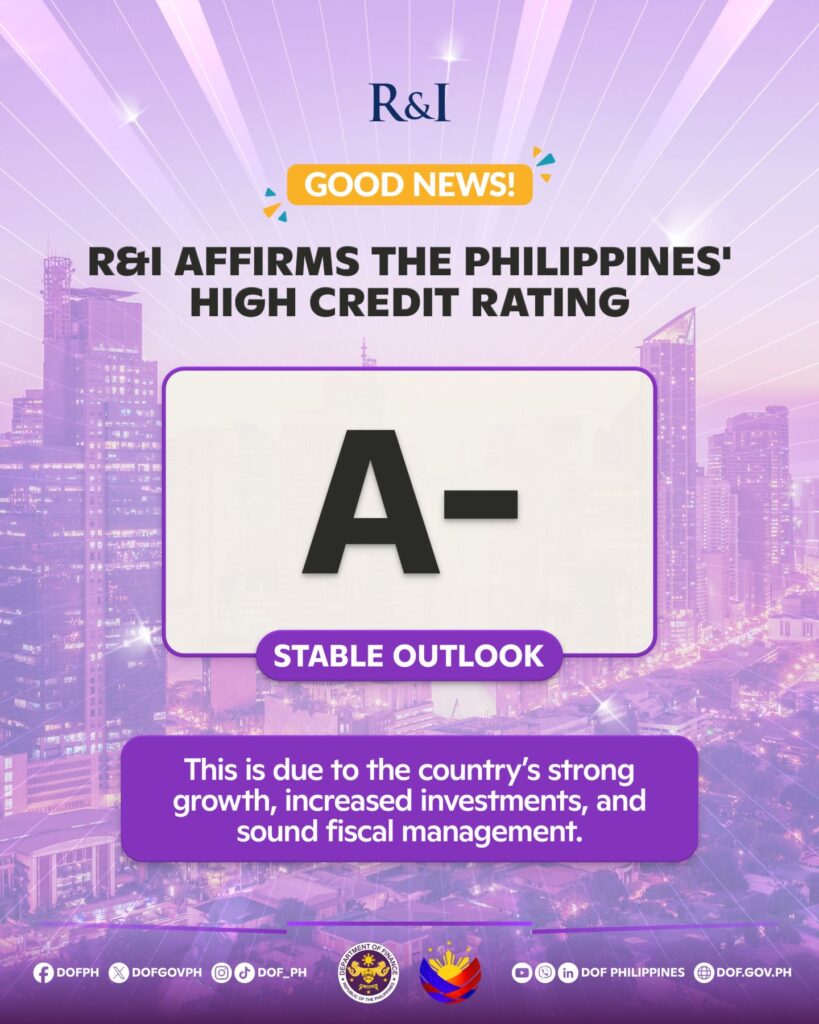
Japan-based credit rating agency Rating and Investment Information, Inc. (R&I) has affirmed the Philippines’ high investment-grade ‘A-’ rating with a stable outlook, underscoring the country’s robust economic growth, rising private and public investments, and sound fiscal management.
“Isa itong tagumpay na dapat ipagdiwang ng bawat Pilipino. Dahil ibig sabihin nito, nananatiling mataas ang tiwala ng mga credit rating agencies at investors sa atin. Kaya mas dadami ang papasok na investments, mas maraming magandang trabaho ang malilikha, mas tataas ang kita, at mas maraming Pilipino ang maiaahon natin sa kahirapan,” Finance Secretary Ralph G. Recto said.
R&I upgraded the Philippines to the coveted ‘A-’ level in August 2024, which was the country’s first-ever A-rating upgrade under the Marcos Jr. administration.
Need a place to stay? Book Your Hotel in Bukidnon and anywhere in the world
Need transportation? Book your bus, flight, ferry/boat, train here
YOU CAN ALSO BOOK BY CLICKING BELOW:
Klook.comAn ‘A-’ rating reflects strong macroeconomic stability and robust creditworthiness. This translates to lower interest rates on borrowings of the national government and the private sector, and helps attract more foreign direct investments.
For the government, funds that would have otherwise been allotted for interest payments could be channeled towards more infrastructure projects, improved social services, a better health care system, and quality education.
Strong growth compared to its peers
In reaffirming its rating, R&I cited that the Philippine economy continues to grow at a relatively high rate among major countries in Southeast Asia.
In the second quarter of 2025, the Philippines’ GDP growth of 5.5% outperformed its regional peers, including China (5.2%), Indonesia (5.1%), Malaysia (4.5%), Singapore (4.3%), and Thailand (2.8%).
Growth was driven by robust domestic demand, which was supported by the sustained deceleration of the inflation rate, which fell to 0.9% in July 2025.
Rising public and private investments
R&I recognized that public and private investments are expected to continue rising, especially the expansion of IT-BPM and manufacturing bases in the area of electronics sector centered on semiconductors.
“The Philippines is expected to realize stable economic growth as well as higher income level against the backdrop of robust public and private investments, development of domestic business such as Information Technology and Business Process Management industry, and population growth, among other factors,” R&I said in its report.
These are being supported by the government’s aggressive push to encourage more private sector participation, such as the Public-Private Partnership (PPP) Code and the Corporate Recovery and Tax Incentives for Enterprises to Maximize Opportunities for Reinvigorating the Economy (CREATE MORE) Act.
Meanwhile, the rating agency believes that the impact of reciprocal tariffs imposed by the US is estimated to be limited as the tariff rate is kept low at 19% and the small proportion of exports to the US in the overall economy.
Steady fiscal consolidation with decreasing deficit and manageable debt
R&I reaffirmed the Philippines’ steady fiscal consolidation, highlighting the government’s progress in reducing the fiscal deficit and improving debt metrics in line with its fiscal strategy.
“R&I believes that the government debt ratio will remain within manageable level with the progress in reducing fiscal deficits,” the debt-watcher said.
“The country has a certain level of debt affordability, given manageable interest payment burden,” it added.
With higher government revenue collections and improved expenditure management, the fiscal deficit dropped from the pandemic high of 8.6% in 2021 to 5.5% in 2025 and is expected to go down to 4.3% by 2028. It is projected to further drop to around 3% by 2030.
The Marcos, Jr. administration has already made improvements in the country’s debt metrics by prioritizing domestic, long-term, and fixed-rate borrowings. It will continue to adopt a borrowing mix in favor of local sources to take advantage of domestic liquidity and mitigate foreign exchange risks.
Secretary Recto earlier emphasized the government’s firm commitment to strictly adhere to its refined Medium-Term Fiscal Program, which is expected to drive the Philippine economy’s expansion to PHP 42.6 trillion by 2030 while keeping debt at a manageable PHP 24.7 trillion, or about 58% of GDP.